
Why Businesses Stop Scaling... and How to Prevent It
Most business owners believe growth eventually becomes a time problem.
I don't.
I believe businesses stop growing because their owners become the bottleneck.
For years, I thought the answer was simply to become more productive. Wake up earlier. Work longer. Delegate more. Build better systems. While all of those things can certainly help, I've come to believe they're addressing a symptom rather than the root cause.
The real challenge isn't time. It's ownership.
The Concept of Effective Capacity
Every business owner has what I've started calling their Effective Capacity.
Effective Capacity isn't the maximum amount of work you can physically complete in a day. It's the maximum amount of complexity you can effectively own while continuing to make consistently good decisions.
Those are two very different things.
Most of us can push through another week of long hours if we have to. We can answer more emails, attend more meetings, and solve more problems. But eventually something begins to change. Decisions take longer. Priorities become less clear. The team waits for approvals that never seem to come quickly enough. Strategic thinking gets replaced by constant reaction.
The business hasn't necessarily outgrown the market.
It's outgrown the owner's Effective Capacity.
Why Working Harder Eventually Fails
When we feel overwhelmed, our natural instinct is usually to work harder.
We've all done it.
We stay late. Wake up earlier. Cancel vacations. Answer emails on weekends. Tell ourselves we'll just push through this busy season.
Sometimes that works for a while.
But eventually we discover that working harder doesn't actually increase our Effective Capacity. It only postpones the consequences.
The real limitation isn't our willingness to work.
It's the amount of complexity that can effectively flow through one person before they become the bottleneck.
The Ownership Rotation Framework
This realization fundamentally changed how I think about leadership.
I no longer believe our responsibility as business owners is to continually increase our capacity forever. Every leader eventually reaches a practical limit.
Instead, I believe our responsibility is to continuously rotate ownership upward.
Every responsibility we intentionally transfer to the right person, leader, or system creates room for us to own something more valuable.
That's an important distinction.
The goal isn't to create less work for ourselves.
The goal is to continually move our ownership toward the work that creates the greatest impact.
Scaling isn't about carrying more.
It's about carrying different things.
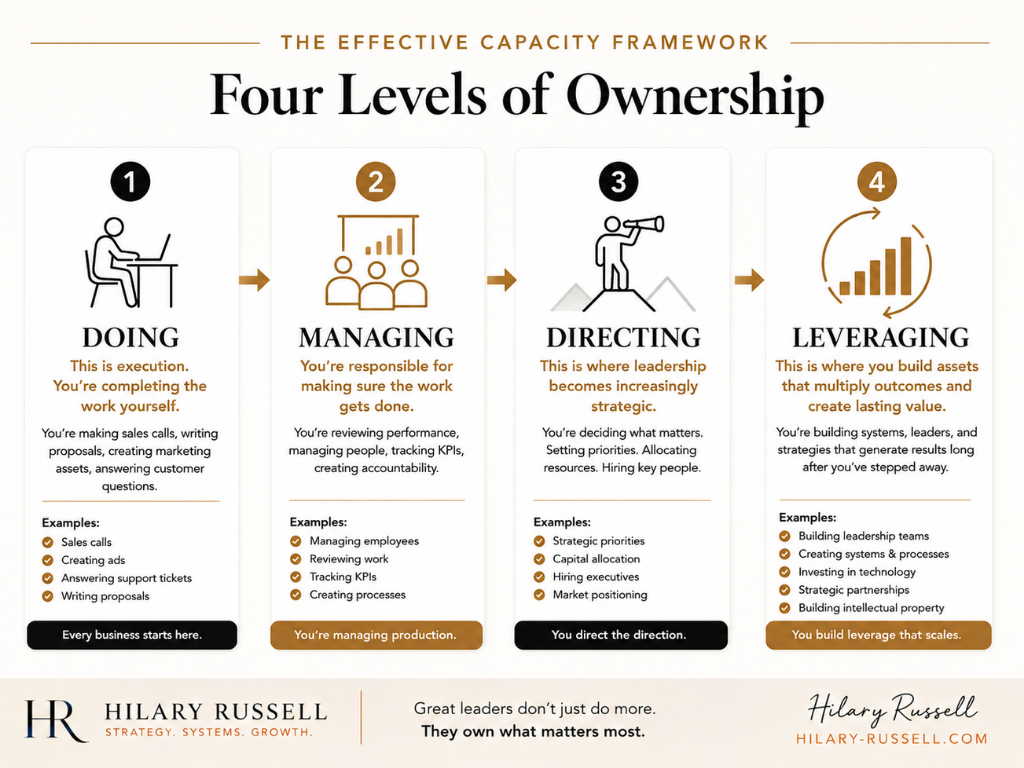
The Four Levels of Ownership
As I've thought through this framework, I've found that nearly every responsibility in a business fits into one of four levels of ownership.
Level 1: Doing
At the first level, we create value by doing the work ourselves.
This is where every business begins. We're making sales calls, serving customers, writing proposals, building marketing campaigns, solving problems, and wearing every hat imaginable.
There is absolutely nothing wrong with this stage. In fact, it's necessary.
The challenge comes when our business has outgrown our need to personally execute, but we continue operating as though it hasn't.
Level 2: Managing
Eventually our value shifts from producing work to ensuring the work gets done well.
We're managing people, reviewing performance, creating accountability, documenting processes, and building consistency throughout the organization.
Instead of multiplying our own effort, we're beginning to multiply the efforts of others.
Level 3: Directing
As the business continues growing, our greatest contribution becomes the quality of our decisions.
We're setting priorities, allocating resources, hiring leaders, deciding what opportunities to pursue, and determining where the company is headed next.
At this level, one good decision often creates more value than weeks of personal execution.
Level 4: Leveraging
The highest level isn't about doing more.
It's about creating leverage.
We're building leadership teams that make great decisions without us. We're developing systems that continue producing results long after they're implemented. We're creating intellectual property, strengthening culture, allocating capital, investing in technology, and making strategic decisions that influence the entire organization.
Our value no longer comes from our individual effort.
It comes from creating assets that multiply the efforts of everyone else.
Rotating Ownership Upward
This framework has changed one question I ask myself.
Instead of asking, "How can I get more done?"
I now ask, "What am I still owning that my business no longer needs me to own?"
That's a completely different question.
Every responsibility we successfully rotate downward creates space to rotate our ownership upward.
Over time, we stop spending our days solving yesterday's problems and start focusing on tomorrow's opportunities.
A Different Way to Think About Scaling
I think many of us have unintentionally defined growth as carrying more responsibility.
The longer I build businesses, the less I believe that's true.
Real growth happens when our ownership evolves alongside the business.
The founder who once answered every customer call eventually builds a customer success team.
The owner who once approved every invoice develops financial controls.
The CEO who once managed every employee builds leaders who manage other leaders.
Ownership continuously rotates upward.
A Final Thought
I believe every business eventually grows to the size of its owner's Effective Capacity.
The businesses that continue scaling aren't led by people who somehow become infinitely more productive than everyone else.
They're led by owners who intentionally rotate their ownership toward higher-value decisions while building people and systems capable of owning everything below them.
Working longer hours stopped being impressive a long time ago.
Building organizations that continue growing because of the leaders and systems we've built—that's the real objective.
I think that's what leadership is really about.